How to Report Women Harassment in Punjab | VWPS
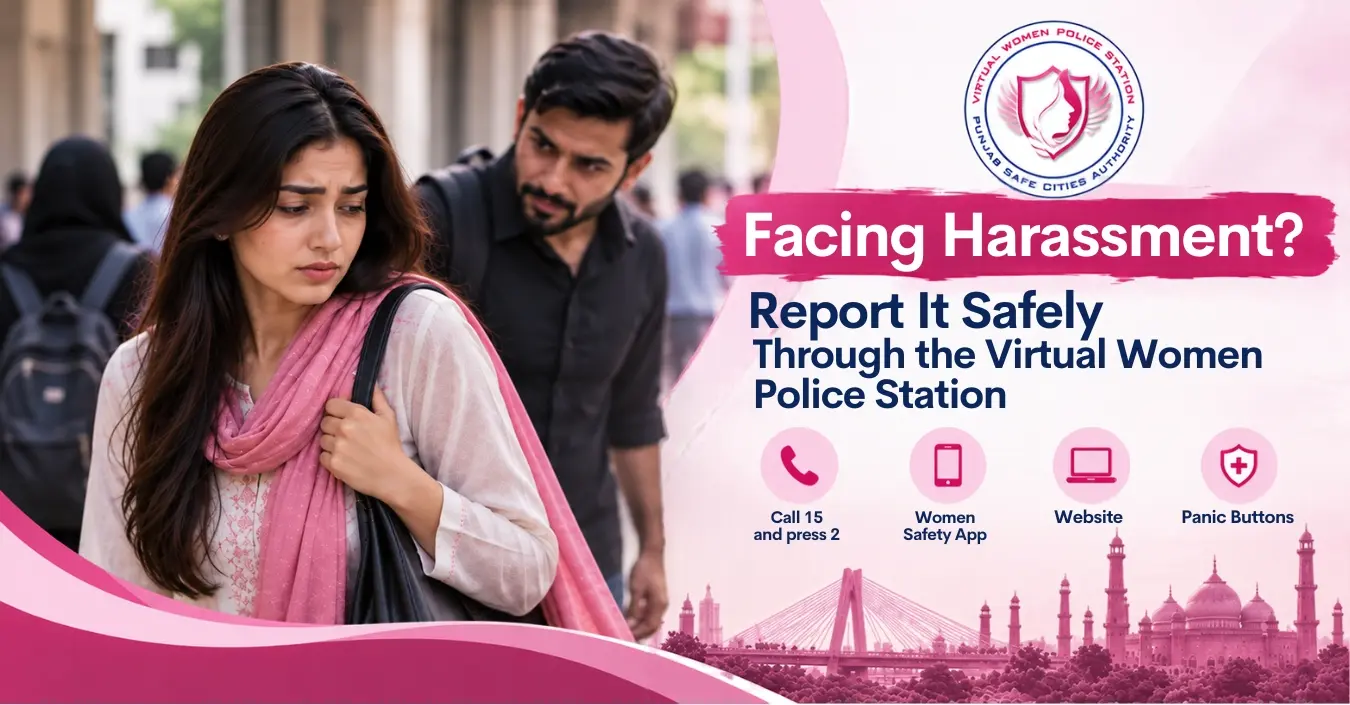
Imagine walking home from college or work when someone starts following you or making unwanted comments. Perhaps you receive threatening messages on your phone, or someone repeatedly contacts you despite your requests to stop. You may feel worried, confused, or unsure about what to do next.
For many women in Punjab, reporting harassment is not easy. Fear of family pressure, social judgment, or the consequences of speaking up can make a woman hesitate. Some women do not know where to report an incident or whether anyone will listen to them.
You deserve to feel safe, respected, and heard. Harassment is not your fault, and you do not have to face it alone.
The Virtual Women Police Station (VWPS), an initiative of the Punjab Safe Cities Authority (PSCA), provides a convenient way for women across Punjab to seek police assistance. Launched on April 22, 2024, VWPS is available 24/7 and allows women to report harassment, threats, and violence without visiting a police station.
Whether you are a student, a working woman, a homemaker, or someone facing harassment online, VWPS can help you understand the reporting process and connect you with the police. This guide explains what harassment means, your rights under Pakistani law, and how to make a harassment complaint safely.
What Counts as Harassment?
Harassment can happen in public, at work, at home, or online. It is not limited to physical contact. Unwanted behaviour, threats, and actions that make you feel unsafe may also need police attention.
Knowing the types of harassment can help you understand when to ask for help.
Street and public harassment
Women may experience unwanted comments, gestures, following, or repeated attempts to approach them in streets, markets, public transport, educational institutions, or other public places. Such behaviour can cause fear and make everyday activities difficult.
Workplace harassment
Workplace harassment may include unwanted personal comments, inappropriate messages, repeated unwanted attention, or behaviour that creates an intimidating or uncomfortable working environment. It can involve a colleague, supervisor, employer, or another person at work.
Every woman deserves to work in an environment where her dignity and rights are respected.
Online and cyber harassment
Online harassment can happen through social media, messaging apps, phone calls, or other digital platforms. Examples include threatening messages, blackmail, fake profiles created to misuse someone’s identity, stalking through digital accounts, and sharing private pictures without consent.
If you are experiencing online harassment in Pakistan, save the available evidence and seek help. You do not need to handle threats or blackmail on your own.
Domestic violence, threats, and stalking
Harassment and violence may also occur within the home or involve someone a woman knows. Threats, repeated unwanted contact, stalking, intimidation, and abusive behaviour should not be ignored simply because the person responsible is a relative, acquaintance, or partner.
You have the right to ask for help, regardless of who is responsible or where the incident occurred.
Know Your Rights Under Pakistani Law
Pakistani law offers protection to women facing harassment or violence at home, at work, in public places, and online. The law that applies depends on the incident. You can report what happened without knowing the relevant legal section.
1. Pakistan Penal Code (PPC), Section 509
Section 509 deals with insulting a woman’s modesty, invading her privacy, and certain forms of sexual harassment. The punishment can be up to three years in prison, a fine of up to Rs. 500,000, or both. Other relevant provisions include Section 354, which concerns assault intended to outrage a woman’s modesty, and Section 506, which deals with criminal intimidation.
2. Workplace Harassment Law
Women who experience harassment at work can seek support under the applicable workplace harassment laws in Pakistan. Depending on the organisation and the relevant legal framework, complaints may be submitted to an internal inquiry committee or the appropriate Ombudsperson. Changes introduced to federal legislation in 2022 broadened its coverage to include additional work arrangements and address gender-based discrimination. Punjab also has applicable provincial legal provisions governing workplace harassment.
3. Prevention of Electronic Crimes Act (PECA), 2016
PECA covers several offences committed online or through electronic devices, including:
- Section 16: Unauthorised use of another person’s identity information.
- Section 20: Certain false information shared publicly that harms a person’s reputation or privacy.
- Section 21: Specified offences involving sexually explicit material and intimate images shared without consent.
- Section 24: Cyberstalking, including certain forms of repeated unwanted contact and electronic harassment.
The National Cyber Crime Investigation Agency (NCCIA) handles investigations under PECA, as amended in 2025. VWPS can guide women on reporting online harassment and help them access Punjab Police support if they also face physical threats or violence.
4. Punjab Protection of Women against Violence Act, 2016
This law protects against violence covered by the Act. Women can seek protection, residence, monetary, or interim orders through the competent court. Women Protection Officers and relevant protection services can also help them access support.
This information is for general guidance and is not a substitute for legal advice. For help with your situation, contact VWPS or a qualified lawyer. In an emergency in Punjab, call Police Helpline 15. To report an online offence under PECA, visit the NCCIA complaint portal.
What Is the Virtual Women Police Station?
The Virtual Women Police Station is a government service established by PSCA on April 22, 2024, to help women aged 18 and above across Punjab report harassment, threats, and violence.
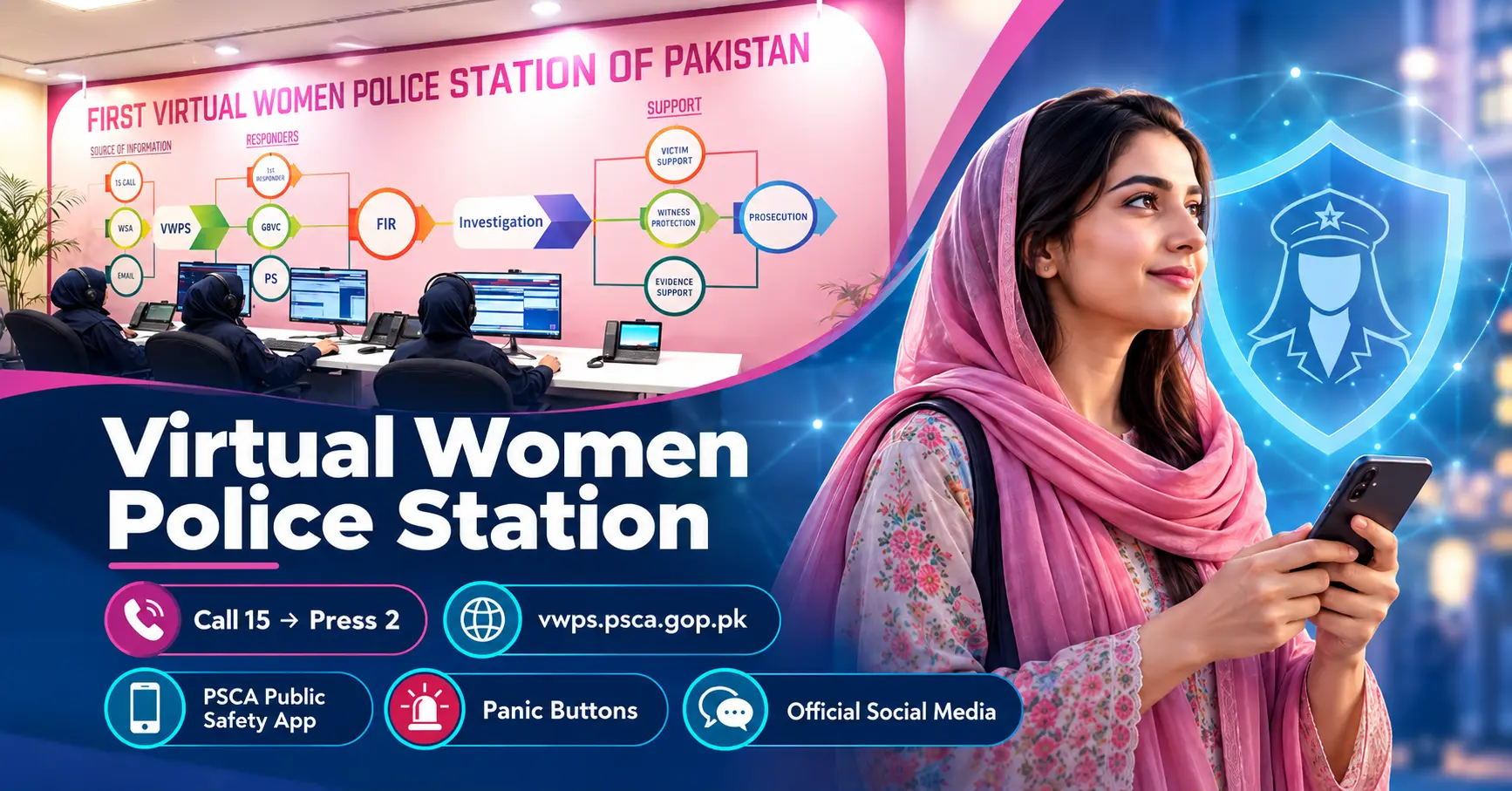
Its purpose is to make police assistance more accessible. Women can reach trained female police officers through the toll-free Punjab Emergency Helpline 15, the Women Safety App, the PSCA Public Safety App, the VWPS website, and panic buttons.
VWPS operates 24/7 and works closely with Punjab Police and police stations across the province. Female police officers listen to complaints, record the details, register cases, and dispatch police when required.
The service offers several important benefits:
- Available across Punjab, 24 hours a day.
- Free access through the government service and toll-free helpline.
- Trained female police officers who handle complaints.
- Police assistance for urgent situations and other reported incidents.
- Legal guidance and support throughout the process.
- Digital reporting options for women who find it difficult to visit a police station initially.
VWPS also helps women understand what happens after a complaint is made. If a police station visit is needed for FIR registration, the team stays in contact with the woman and the concerned police.
VWPS handles cases involving women aged 18 and above. Cases involving children under 18 are handled by Mera Pyara, the Virtual Center for Child Safety.
Step-by-Step: How to Report Through VWPS
If you are facing harassment and want to report it, follow these steps.
- Call 15 and press 2. Dial the toll-free Punjab Emergency Helpline 15 and select option 2 to connect with VWPS. The helpline is available 24/7.
- Explain what happened. Share your name, location, the concerned police station, and the nature of the incident. Explain your concern in simple words. You do not need to know the correct legal term for what happened.
- Speak with a female police officer. A trained female police officer will listen to you, record the details, and register the case. Share the information as accurately as possible so the team can understand your situation.
- Receive police assistance. Police are dispatched to the location when required. In emergencies, police can reach the location within minutes after the case is created.
- Get guidance on the next steps. VWPS provides legal guidance and support throughout the process. If a visit to the concerned police station is needed to register an FIR, the team stays in contact with you and the police.
If you are unsure whether your experience qualifies as harassment, you can still explain your concern and seek guidance. Do not let uncertainty about legal terms prevent you from asking for help.
You can report an incident that happened recently or one that occurred in the past. If you are in any danger, seek emergency police assistance without waiting to collect evidence.
Other Ways to Reach VWPS
Calling 15 and pressing 2 is not the only way to reach VWPS. Women across Punjab can also use the following reporting channels.
Women Safety App
The Women Safety App provides access to VWPS and includes a video call option. You can use it to speak face-to-face with a female police officer.
If you cannot speak or type safely, the app also allows you to report an incident silently. Its evidence-sharing feature lets you connect your phone camera with PSCA to share evidence.
Download the Women Safety App on Google Play.
PSCA Public Safety App
The women safety feature is also available in the PSCA Public Safety App. You can use this option to access the available women safety reporting service.
VWPS website
You can contact VWPS through the official website’s contact page:
Visit the VWPS Contact Us page.
Panic buttons
Panic buttons provide another way for women to reach VWPS. They can be used to seek assistance when a woman needs help through this reporting channel.
Language support through Helpline 15
Helpline 15 is available in Urdu by default. Callers can also choose regional languages, including Saraiki and Pothohari.
You do not need to be fluent in English to report harassment. Choose the language in which you are most comfortable explaining your situation.
How to Prepare Before Reporting
You do not need to have a complete set of evidence before contacting VWPS. Your safety comes first, especially if someone is threatening or following you.
However, if it is safe to do so, keeping relevant information can help explain what happened.
Consider saving:
- Screenshots of threatening or harassing messages.
- Relevant chat conversations and social media messages.
- Call logs showing repeated unwanted contact.
- Dates, times, and locations of incidents.
- Details of the account or profile involved in online harassment.
- Any other information that may help explain the incident.
Do not delete chats before saving the available proof. Keep copies of relevant messages and screenshots where you can access them safely.
If someone is threatening to share private pictures or is blackmailing you, avoid handling the situation alone. Do not put yourself at further risk to collect evidence or confront the person.
You can report the incident even if you have limited evidence. Explain what happened honestly and provide the information you have.
What Happens After You Report?
After you report an incident, VWPS records the details and arranges police assistance as required. The department works closely with the concerned police station to support further action.
In emergencies, the response is immediate, and police can reach the location within minutes after the case is created. The appropriate response depends on the circumstances and the nature of the incident.
After the initial response, police from the concerned police station contact the complainant regarding legal action and further court proceedings, where applicable.
A tracking number is not issued. However, the VWPS team follows up on cases itself, and you can obtain updates at any time by calling Helpline 15.
In some cases, a visit to the police station may be needed to register an FIR. If this happens, VWPS stays in contact with both the woman and the concerned police so that she receives support during the process.
For online harassment, VWPS acts promptly where Punjab Police assistance is needed. If a case requires action from another relevant agency, it can be escalated to that agency.
VWPS has reported the following official figures:
- 1,212,092 cases received
- 1,112,764 cases resolved
- 95,568 FIRs registered
These figures reflect the scale of complaints handled through the service.
Your Privacy and Safety Are Protected
One of the biggest reasons women hesitate to report harassment is the fear that others may find out. A woman may worry about family pressure, social judgment, or how people around her will react.
These concerns can feel difficult, but they should not prevent you from seeking help when you need it.
VWPS has a privacy policy and does not share information with any third party. Complaints are kept confidential where needed, helping women approach the service with greater confidence.
However, identity verification is required before VWPS can take action. Complaints cannot be made anonymously. You should provide accurate information when reporting an incident.
If you are worried about your safety at home or about someone accessing your phone, consider using a safer way to contact VWPS when possible. You can seek assistance through the reporting channels available to you.
Your safety and dignity matter. Asking for police assistance is a responsible step towards addressing harassment and protecting your rights.
How Family and Friends Can Help
A woman who experiences harassment may need emotional support as well as police assistance. A calm and respectful response from family members and friends can make it easier for her to seek help.
If someone tells you about harassment, listen without judging her. Avoid asking questions that suggest she is responsible for another person’s behaviour.
Respect her concerns about privacy and safety. Offer to help her contact VWPS, save relevant evidence, or understand the reporting process.
A sister, friend, or mother can also report an incident on a woman’s behalf. However, it is better for the woman herself to report whenever possible, because she can provide accurate details and help ensure the case is created properly.
Families can make a meaningful difference by supporting women rather than pressuring them to remain silent. A safe home and a supportive community can help women take the next step with confidence.
Conclusion: Take the First Step Towards Safety
Harassment should never be accepted as a normal part of a woman’s life. Whether it happens on the street, at work, at home, or online, every woman deserves to be treated with dignity and to seek help without blame or shame.
The Virtual Women Police Station makes it easier for women across Punjab to reach trained female police officers, report concerns, and receive police assistance. The service is free, available 24/7, and designed to help women take the first step towards safety.
If you or someone you know is facing harassment, do not let fear or uncertainty stop you from seeking support.
You can take action through any of these official VWPS reporting channels:
- Call the toll-free Emergency Helpline 15 and press 2.
- Report through the Women Safety App.
- Use the women safety feature in the PSCA Public Safety App.
- Contact VWPS through the official website.
- Use panic buttons to seek assistance.
Your voice matters. Asking for help is a step towards protecting yourself and your rights. If a woman you know is facing harassment, help her find the support she deserves.
Frequently Asked Questions (FAQs)
1. How can I report harassment in Punjab?
Call the toll-free Punjab Emergency Helpline 15 and press 2 to connect with VWPS. You can also use the Women Safety App, the women safety feature in the PSCA Public Safety App, the VWPS website, or panic buttons.
2. Is the Virtual Women Police Station available 24/7?
Yes. VWPS operates 24 hours a day, seven days a week, and serves women across Punjab.
3. Is VWPS free to use?
Yes. VWPS is a Government of Punjab service, and Helpline 15 is toll-free.
4. Can I report online harassment through VWPS?
Yes. You can report online harassment, including relevant threats and blackmail concerns. VWPS provides Punjab Police assistance where needed and escalates cases to other relevant agencies when required.
5. Can I report harassment that happened in the past?
Yes. You can report past incidents as well as recent ones. Explain the circumstances and provide any available evidence.
6. Will my identity remain confidential?
VWPS keeps complaints confidential where needed and has a privacy policy that does not allow information to be shared with third parties. However, identity verification is required for action, so complaints cannot be anonymous.
7. Do I need to visit a police station after reporting?
Not in every case. However, a visit may be needed to register an FIR. If this happens, VWPS remains in contact with you and the concerned police to provide support.
8. Can I report harassment on behalf of another woman?
Yes. You can report on behalf of your sister, friend, or mother. However, it is better for the woman herself to report whenever possible, so the information is accurate and the case is created properly.
9. Can girls under 18 contact the Virtual Women Police Station?
No. VWPS is intended to assist women aged 18 and above. Cases involving children under 18 are handled by Mera Pyara - Virtual Centre for Child Safety (VCCS), a PSCA initiative dedicated to child protection and safety.
Dial 15 and press 2 for the Virtual Women Police Station. Free, confidential and answered by trained women officers, 24/7.